The legal situation involving the push to legalize same-sex marriage in most of the states is rapidly changing. As of today new lawsuits in Wisconsin, Missouri, and Louisiana are expanding the states with legal challenges to same-sex marriage bans. A previous lawsuit in Louisiana was dismissed in December over legal standing issues.
Also, a new lawsuit in Ohio does not seek the legalization of same-sex marriages at the state level there. Instead it seeks to have the names of both parents listed on birth certificates when an Ohio or out-of-state adopting couple are legally married elsewhere. This Ohio case would expand on an earlier Federal judge's ruling that Ohio must list same-sex spouses legally married elsewhere on Ohio death certificates. That case is being appealed.
And today a Federal judge in Texas is hearing a challenge to that state's same-sex marriage ban. Nevada's Attorney General also announced she will not defend Nevada's same-sex marriage ban from a legal challenge there because of the ban's likely unconstitutionality.
UPDATE: Even as I posted this map over lunch, a Federal judge in Louisville, KY, ruled that my home state of Kentucky must recognize same-sex couples legally married in other states. This particular lawsuit did not address whether same-sex couples could marry in Kentucky. So now Kentucky will either join Oregon in recognizing same-sex couples married elsewhere or join Utah and Oklahoma in appealing this ruling.
Middling America is somewhere between the United States and 'Merica. This blog is dedicated to exploring data on the "Typical American's" views on social and political trends.
Wednesday, February 12, 2014
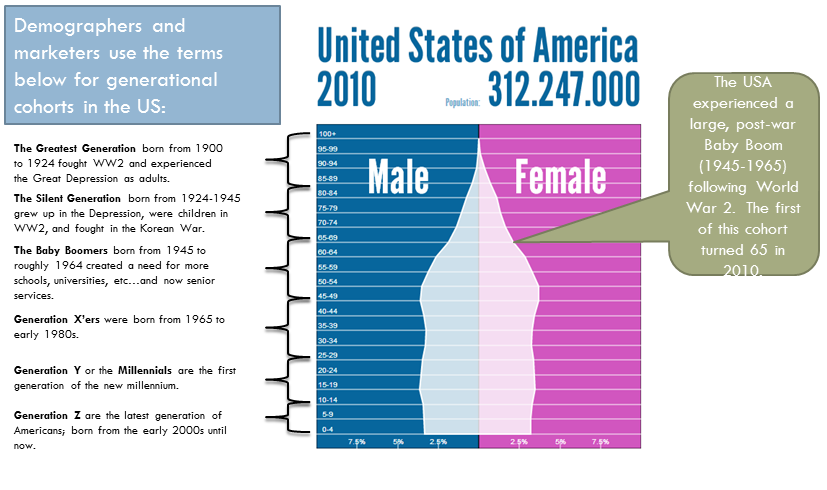
Gen X? Millennial?
The typical American currently belongs to Generation X.
Monday, February 10, 2014
The Typical American and Her Wheels
What can the American Community Survey (ACS) tell us about the typical American? Well, Americans use cars a lot:
- Jennifer, our typical American, and her husband have 2 or more vehicles (57.3%).
- Like 76.1% of workers 16 years and older, Jennifer drives to work alone.
- Her average commuting time to work is 25.4 minutes.
Friday, February 7, 2014
Of Marijuana and Money
Currently nineteen states and DC have legalized marijuana for medical uses. Two more, Colorado and Washington, have gone a step farther and lifted the prohibition on recreational use of marijuana. Several other states have had ballot measures to legalize marijuana either for medical uses or recreational uses. The New Hampshire House this month voted to legalize recreational use there.
The legalization of cultivating and selling marijuana, however, creates a number of financial and regulatory issues:
First, Federal laws forbid banks from allowing accounts where marijuana proceeds -even legal ones- would be deposited. Banks can face Federal racketeering charges. As a result, pot farmers and dispensaries deal almost completely in cash. Imagine paying your taxes -in cash. Imagine paying your employees -in cash. Imagine paying your vendors -all in cash. No bank will give you a loan to start your business. Where are you going to store the thousands of dollars your business brings in daily? Imagine the security concerns.
From the perspective of the business owners, the ban on banking even legal marijuana money is a huge headache -and a dangerous one with so much cash floating around.
States like Colorado and Washington see big tax dollars in recreational marijuana sales, but the banking problems also make the industry ripe for tax evasion.
The US Justice Department is currently working on new regulations that would open the way for banks to treat marijuana businesses that same as other legal businesses -in those states where marijuana has been legalized. Several members of Congress, however, have come out opposing the changes. 2014 will likely see a number of new issues and opportunities open for the marijuana industry.
The legalization of cultivating and selling marijuana, however, creates a number of financial and regulatory issues:
First, Federal laws forbid banks from allowing accounts where marijuana proceeds -even legal ones- would be deposited. Banks can face Federal racketeering charges. As a result, pot farmers and dispensaries deal almost completely in cash. Imagine paying your taxes -in cash. Imagine paying your employees -in cash. Imagine paying your vendors -all in cash. No bank will give you a loan to start your business. Where are you going to store the thousands of dollars your business brings in daily? Imagine the security concerns.
From the perspective of the business owners, the ban on banking even legal marijuana money is a huge headache -and a dangerous one with so much cash floating around.
States like Colorado and Washington see big tax dollars in recreational marijuana sales, but the banking problems also make the industry ripe for tax evasion.
The US Justice Department is currently working on new regulations that would open the way for banks to treat marijuana businesses that same as other legal businesses -in those states where marijuana has been legalized. Several members of Congress, however, have come out opposing the changes. 2014 will likely see a number of new issues and opportunities open for the marijuana industry.
Wednesday, February 5, 2014
What's Up with Booming North Dakota?
North Dakota's situation involves two factors: one a long-term demographic trend and the second the recent find of oil in the Bakken formation.
Like many rural areas, the Great Plains have been steadily losing people as many younger and working age people leave for jobs, potential mates, and other amenities in bigger cities. The people who remain behind tend to mature into old age there. Thus, this demographic phenomena is called aging in place. Unlike popular retirement states such as Florida and Arizona, the Great Plains' seniors usually grew up and never left the rural communities that are their homes. In much of rural North Dakota, unemployment is low in part because there are few working age North Dakotans to take jobs being vacated by retiring seniors.
The second factor that is making North Dakota boom and attract a sudden influx of working age people is the discovery and development of the Bakken oil field under western North Dakota. In places like Williston, ND, jobs are plentiful and housing is hard to find. Like earlier boomtowns, the discovery of oil has led to a sudden influx of workers and the infrastructure in these rural areas is trying to catch up to all the new residents.
Monday, February 3, 2014
Map: Where You Are Most Likely to Be Stuck in a Part-time Job
This map looks at the percentage of workers who want a full-time job but can only find part-time work. In technical terms, this map shows the highest rates of underemployment in the United States.
The Western states of Nevada, California, Oregon and Washington have considerably higher underemployment. North Dakota and South Dakota have low overall unemployment and relatively few part-time workers unable to find full-time work.
UPDATE: The Typical American, English Language
Last night's Super Bowl commercial by Coca Cola featured various Americans singing America the Beautiful in different languages. Strangely to me this commercial has triggered a backlash by the more xenophobic elements in American society. Here's the commercial on YouTube and some statistics on the 1 in 5 Americans whose first language is not English. America, c'est belle, no?
This backlash reminds me of a story floating around the web about two people waiting in line at the supermarket. One person, a woman, is talking to a family member on the phone. When she hangs up, the man behind her tells her that this is America and that if she wants to speak 'Mexican' she needs to go back to Mexico. She looks him in the eye and informs him she was speaking Navajo and that if he wants to speak English he can go back to England. ;)
From its earliest days, the US has been a melting pot of languages from around the world. The Founding Fathers almost voted to make German the language of government back in the 1700s! In the 13 British colonies which became the original states, English was the most widespread language.
According to data from the 2012 American Community Survey, English still dominates with 4 out of 5 Americans speaking only English at home. Yet, a sizeable number of Americans -1 in 5- do speak other languages at home.
Case in point: A few years ago I looked into having a survey of Kentucky high school children translated into other languages. When I checked, I found out that Kentucky schools -yes, Kentucky, not the most diverse state by any means- taught children whose primary languages included over 70 different languages! While English is the most common language in Kentucky schools and Spanish is the second most common, I was surprised that the third most common was Bosnian. Kentucky has a rather sizeable Bosnian immigrant population who came to the area as war refugees.
Subscribe to:
Posts (Atom)