
Monday, May 26, 2014
More of the Typical American's Health

Friday, May 23, 2014
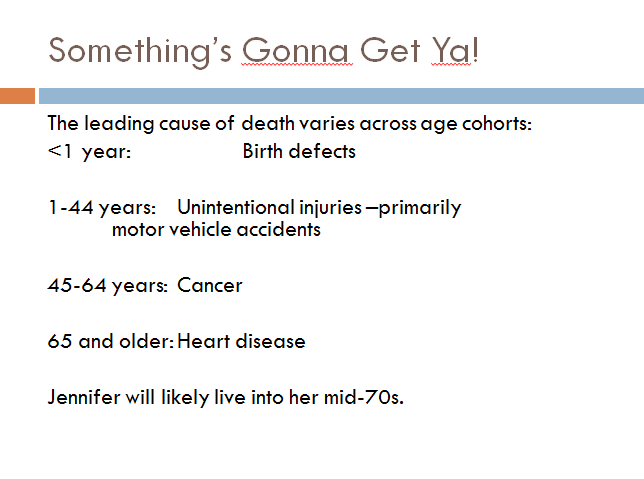
Americans Die of Different Things at Different Ages
Wednesday, May 21, 2014
The Typical American's Death

Monday, May 19, 2014
The Typical Human's Genetics
 |
| Photo Credit: farmspeedracer via Compfight cc |
 |
| Photo Credit: Yennie ~ need more dolly time..:( via Compfight cc |
Likewise, green eyes are the rarest.
In terms of blood types, the rarest of the 4 primary blood types is AB negative.
Friday, May 16, 2014
The Typical American's Voting Practices

Wednesday, May 14, 2014
What If: The Missouri and Crittenden Compromises

One of the more fascinating theories in modern physics is the concept of the multiverse where each decision made creates multiple universes. So, in one universe you chose strawberry ice cream today. In another you chose chocolate. In another you chose vanilla. It opens the door to wondering what if such-and-such has happened differently in another universe.
My partner is taking an American history class this semester and on a long car trip we read American history to each other. Of interest to me was the Missouri Compromise. For the past 15 years I have lived two blocks from the former home of Henry Clay, the early 19th century Kentucky master politician who guided the passage of the Missouri Compromise through Congress. I was intrigued about the geopolitical implications of this law if it had continued into later American history.
For those of you -like myself- a little hazy about the Missouri Compromise, it was a law passed in 1820 to keep the peace between the Southern and Northern states. Forty-four years after the Declaration of Independence, the North and South were quickly becoming very different Americas. Both regions economies were primarily based on agriculture, but the North was rapidly industrializing and desired a stronger Federal government that would invest tax dollars in industrial and transportation infrastructure and place higher tariffs on foreign imports. Slavery was also largely illegal in the North. The South on the other hand was politically ran by the plantation-based, export-oriented planters making up 1% of the South's population. While most Southerners were small farmers of modest means, racism, pride, and political manipulation by the very wealthy still led the white male Southern voter to support the slave economies pushed by the wealthy planters. In the South industrialization was far less advanced. Instead the Southern planters exported much of their cotton, indigo, sugar, and tobacco crops overseas to Great Britain and other European buyers. They then bought manufactured goods -and tea- from the British and other Europeans. Thus, Southerners developed a taste for sweet tea and a distaste for tariffs on foreign imports which raised their costs. Southern planters and their local allies opposed a strong Federal government which was suspected of wanting to abolish slavery.
The number of Southern Slave states and Northern Free states were about even by the early 1800s. A crisis ensued when Missouri and Maine applied for statehood. Slavery already existed in Missouri but there was a move to ban slavery in the Louisiana Purchase. After various political tussling, Henry Clay was able to broker and pass the Missouri Compromise that banned slavery in the former Louisiana Purchase north of 36 degrees 30 minutes of latitude (Missouri's southern boundary) except for Missouri. So, Missouri was admitted as a slave state and Maine as a free state. By 1837 there were an even 13 free states in the North and 13 slave states in the South. This uneasy peace lasted until 1854 when the Nebraska-Kansas Act replaced the Missouri Compromise with a system to let Nebraska and Kansas vote individually on whether to be a slave or free state.
When Abraham Lincoln's election in 1860 precipitated South Carolina and other Southern states to secede, another Kentucky politician, John Crittenden, offered a new compromise: extend the 36° 30′ Missouri Compromise line all the way to the Pacific. The so-called Crittenden Compromise failed to pass, and the Civil War ensued.
This map asks what could have happened if the Crittenden Compromise had passed and the South then not seceded. Instead, what if the same uneasy peace of the 1820-1854 had become an entrenched system. Without the South's secession to provoke Federal military action, would the horror of slavery been abolished by 2014? Would the system of admitting two states -one slave and one free- to keep the balance have continued? This map explores this scenario and is based on historical facts:
a. In the US of the Missouri and Critten Compromises, slavery is abolished largely north of the 36° 30′ parallel.
b. Without the Civil War to initiate its breakaway from Virginia, the counties that now constitute West Virginia remain part of the Virginia.
c. To even the free and slave state balance, the Dakota Territory and the Oregon Territory are admitted as single states rather than as North Dakota, South Dakota, Oregon, and Washington. And the once larger Deseret dreamed of by Mormon settlers has come into existence as the state of Deseret, the combination of Utah and Nevada. Keep in mind that some of the first white settlers of Nevada were Mormon farmers who established towns such as Las Vegas.
d. California on the other hand has been split into the free North California and slave South California roughly along 36° 30′ but actually along the Kern-Tulare County boundary.
e. Alaska has been admitted as a free state, but Hawaii and its sugar plantations have legalized human bondage.
f. Arizona, New Mexico, and Oklahoma have been admitted as slave states.
g. When the US annexed the former Mexican province of Texas (by then the independent Republic of Texas), the terms of annexation allow Texas to split into 5 states. This has happened to create North, South, East, West, and Central Texas.
h. Finally, even with 5 mini-Texases and other states, the South is still shy 3 states to have parity with the North. History, however, shows that Southern planters advocated annexing or buying Cuba and other Caribbean islands with a long history of slavery and plantation agriculture. In this scenario Cuba is now a state along with Puerto Rico and the combined US and British Virgin Islands.
The result is a nation of 54 states: 27 free states and 27 where the abomination of slavery still remains legal.
Arkansas and the Marriage Map
I'm traveling and away from my mapping software until late June. So I will not be able to update my marriage map for several weeks. Arkansas, however, now joins the states where legal same-sex marriages have taken places.
Subscribe to:
Posts (Atom)