Showing posts with label demographics. Show all posts

Tuesday, April 7, 2015

Georgia's MUPs


In looking at areas without sufficient medical providers, HRSA designates areas as HPSAs, MUAs, or MUPs (see previous posts on HPSAs and MUAs).  This final map shows Georgia's Medically Underserved Populations (MUPs).  MUPs and MUAs use the same criteria, but an MUP designation evaluates a specific sub-population rather than an entire county.

Thursday, April 2, 2015

Georgia's HPSAs


HRSA also designates areas as HPSAs, Health Professional Shortage Areas, based on a formula.

Tuesday, March 31, 2015

Georgia's Medically Underserved Areas


HRSA, the Health Resources and Services Administration, categorizes areas as MUAs (Medically Underserved Areas) if they score 62 or less on an Index of Medical Underservice.  This score is based on an area's ratio of physicians per 1000 population, infant mortality rate, percentage of residents living below poverty, and the percentage of the population aged 65 or older.  Here is a map of Georgia's MUAs showing that most of the state is medically underserved.


Saturday, September 27, 2014

Some Cities Are Just More City-Like

Some cities are...well...more city-like than others.  Population density is a big factor.  Out in Flagstaff, AZ, the metro area is big and relatively empty with only 7 people per square mile.  A couple of hundred miles west, however, is Los Angeles-Long Beach-Santa Ana where 2,652 people per square mile soak up that southern California sunshine.  I was frankly surprised.  I thought New York City would be America's most dense metro area, but it is now #2 behind LA.  Still, the eastern seaboard cities, Detroit, Cleveland, Chicago, Tampa, south Florida, and the San Francisco Bay area still pack in the people to provide that yummy urban goodness.

Monday, March 31, 2014

Minority Majority States

In demography you lately hear the term majority minority state.  This is a state where non-Hispanic Whites make up less than 50% of the population and where combined minority populations make up the majority.

If we only look at US Census Bureau data for race, Whites represent a minority population only in Hawaii and the District of Columbia.  Minorities make up 42-43% of the populations of California, Maryland, Georgia, and Mississippi, but still are not likely to break the 50% mark in the next few years.

If we add in ethnicity along with race, then more states are minority majority states.  You can be of any race and be Hispanic using the US Census definitions of race and ethnicity.  Thus, many Whites Americans are Hispanic.  In New Mexico, 45% of the population report they are Hispanic.

Adding up all the Americans who belong to racial minorities or are Hispanic Whites will produce four states where racial and ethnic minorities combined are the majority:


  • Hawaii
  • California
  • New Mexico
  • Texas
plus
  • District of Columbia


Friday, March 28, 2014

California's Melting Pot

California is a special state in many ways demographically.  Foremost, more Americans live in California than any other state.  Californians make up 12% of the entire US population.  That means that more than 1 in 8 Americans live in the Golden State.


In terms of race and ethnicity, California also is impressive:


  •  1 in 3 Asian Americans are Californians
  • Almost 1 in 4 Hispanic Americans live in California
  • More Hawaiian Americans and other Pacific Islanders live in California (144K) than in Hawaii (135K)
  • 1 in 5 multi-racial Americans live in California
  • About 12% of all Native Americans and Alaska Natives also call California home
As for Whites and Blacks, Californians represent smaller percentages of these groups.  The Golden State accounts for only 6% of the total US Black population.  One in 10 White Americans are Californians.  

Monday, March 17, 2014

The Typical American, Where Does She Live?

Jennifer, our Typical American, could live in a variety of places depending on how we slice the data.

Wednesday, March 12, 2014

The Typical American, Middle Class Ending?

We often hear politicians, marketers, friends, and family speaking out for the Middle Class, but how do we define just who falls into the Middle Class?

Well, according to the US Census Bureau's American Community Survey, about 78% of Americans fit into the Middle Class if we define that as a household earning a median household income between $15,000 and $149,000 per year.  Another 12% of Americans earn less than $15,000 a year.  And if you and your household earn more than $150,000 a year, you belong to the top 10% of household earners and thus the Upper Class.

If you are smack dab in the middle of the Middle Class, your household earns around $53,000, the median household income.

Median income, however, is on a continuum.  So it is subjective how we define Lower, Middle, and Upper Classes of people.  Moreover, sociologists find that what class people identify with has far more complexity than simply how much money one earns.

In fact, recently the Pew Research Center found that the percentage of Americans who identify as Middle Class has dropped to the point that almost as many Americans now identify as Lower Class.  Americans identifying as Upper Class have also declined since the Great Recession hit at the end of the Bush administration.


Thus, no majority of Americans identify with any social class since around 2011.  Instead, the plurality still identifies as Middle Class but just barely.

Wednesday, February 12, 2014

Gen X? Millennial?

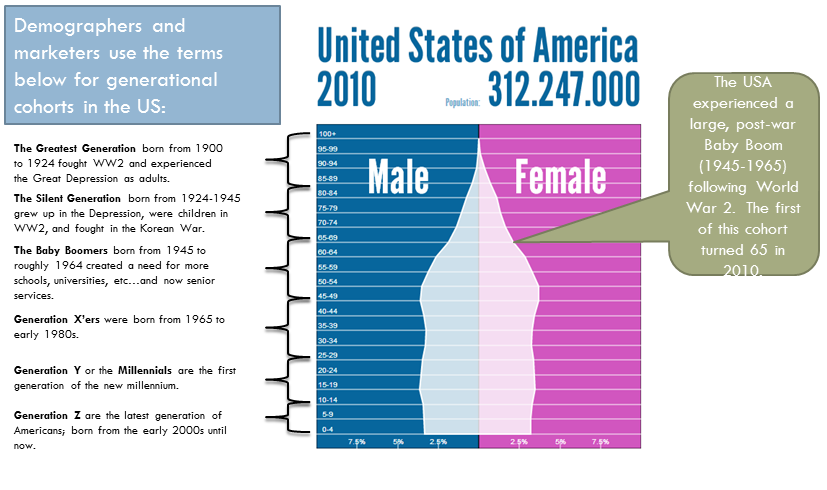
I've heard the terms Baby Boomers, Generation X, and Millennials for years but have not really understood them until I made this graphic for a class of mine.  There is no official definition of when one generation begins and ends, so the years for each generation can vary.

The typical American currently belongs to Generation X.

Wednesday, February 5, 2014

What's Up with Booming North Dakota?


North Dakota is booming!  Yes, the same North Dakota of Fargo movie fame.  The same bitterly cold, flat, windy North Dakota we all know and...love?  North Dakota takes a lot of ribbing for its infamously cold winters, but now the state can also boast of having the lowest unemployment in the United States.  Why though are jobs so plentiful there?

North Dakota's situation involves two factors:  one a long-term demographic trend and the second the recent find of oil in the Bakken formation.

Like many rural areas, the Great Plains have been steadily losing people as many younger and working age people leave for jobs, potential mates, and other amenities in bigger cities.  The people who remain behind tend to mature into old age there.  Thus, this demographic phenomena is called aging in place.  Unlike popular retirement states such as Florida and Arizona, the Great Plains' seniors usually grew up and never left the rural communities that are their homes.  In much of rural North Dakota, unemployment is low in part because there are few working age North Dakotans to take jobs being vacated by retiring seniors.

The second factor that is making North Dakota boom and attract a sudden influx of working age people is the discovery and development of the Bakken oil field under western North Dakota.  In places like Williston, ND, jobs are plentiful and housing is hard to find.  Like earlier boomtowns, the discovery of oil has led to a sudden influx of workers and the infrastructure in these rural areas is trying to catch up to all the new residents.

Tuesday, December 10, 2013

If Only Latinos Voted

As with yesterday's post, CNN's exit polling data are limited for Latino men and women.  Here are the maps for the existing data:


President Obama won more than 7 of every 10 votes by Latinos in 2012.  

Monday, December 9, 2013

If Only Black Women and Black Men Voted


CNN did not collect exit polling data for a number of states in 2012.  In those states where exit polling was conducted, data on the voting preferences of black and Hispanic Americans are also limited.  In some cases the public data shows results for black women but not black men.  Here are the resulting maps.

President Obama won 9 of every 10 votes -or higher- among black voters.


Sunday, December 8, 2013

If Only White Women Voted


While white men voted solidly for former Gov. Mitt Romney and the Republicans in 2012, the pattern for white women is more complicated.  Women voters supported President Obama by 55% (Obama) to 45% (Romney) overall.  On the other hand, only 45% of male voters supported the Democratic ticket.

If you compare the two maps, you can see that majorities of white women and men were mutual in their support for the Obama ticket in only four states:  WA, OR, VT, and MA.  In another 7 states (CA, NY, NH, ME, WI, IA, and MN), white voters split:  white women supported Obama; white men supported Romney.


Saturday, December 7, 2013

If Only White Men Voted, Part 2

Among the states where CNN gathered exit polling data, Romney won overwhelmingly among white men -a core voting bloc for the GOP. A majority of white male voters supported President Obama's re-election in only four states:  WA, OR, VT, and MA.

In fact, the last time a Democratic presidential candidate won a majority of white voters was in 1964 -and race has a LOT to do with this pattern.  In 1860 the Northern states where slavery was abolished voted solidly for Abraham Lincoln, the Republican candidate.  The Democratic Party had splintered between Northern and Southern interests into the National (Northern) Democratic Party and Constitutional (Southern) Democratic Party.  A fourth party, the Whig Party, had been a strong force in US politics for two decades but had dissolved.  Some former Whigs formed a new fourth party, the Constitutional Union Party, that also ran in the 1860 presidential election.

The Southern slave states voted overwhelmingly for the Southern faction of Democrats or the Constitutional Union Party.  Only Missouri voted for the Northern faction of the Democrats.  The united Republicans in the North successfully elected Lincoln to the White House in 1860.  By April of the next year the US was embroiled in its civil war.

After the Civil War, a basic pattern emerged where the North voted primarily Republican and the "Solid South" supported Democrats overwhelmingly.  In 1964, President Lyndon Johnson, a Southern Democrat from Texas, signed the Civil Rights Act into law.  This law ensured American adults regardless of race could vote.  When he signed the law, Johnson pondered that he might be handing the South over to the Republicans.  Sure enough, white voters revolted.  Since the Civil Rights Act was signed into law, former Dixiecrats have moved en masse to the Republican Party.  No Democratic presidential candidate has broken 50% of the the white vote since 1964 -though Carter, a Southerner, almost did with 48% of the white vote in 1976.

Today the party patterns have largely flipped with the Old South a Republican stronghold in terms of national politics.  Likewise, New England moderate Republicans are all but extinct with the former Union states largely voting Democratic in national elections.

You can compare white male voters' outcomes above to the outcomes for each state for the whole population of voters below:


Friday, December 6, 2013

If Only White Men Voted


Check out the full story at Buzzfeed
The folks over at Buzzfeed did a series of interesting maps outlining the 2012 election results if -as was the law before 1870- only white men could vote.  My hat off to Buzzfeed for showing history in a new and intriguing way.

This led me to exploring CNN's 2012 exit polling data in this next series of maps.

Wednesday, October 23, 2013

Just How Many Gay People Are There?

The majority of Americans -incorrectly- believes 1 in 5 Americans are gay.

An interesting 2011 Gallup poll finds that 52% of Americans believe 20% or more of the US population is gay.  Indeed, this poll shows respondents on average believe 1 in 4 Americans are gay.  A hodgepodge of demographic groups report the highest -and likely most incorrect- answers:
  • women
  • lower income respondents
  • Southerners
  • individuals with a high school degree or less
  • Democrats
  • social liberals
  • people who oppose legalization of gay/lesbian relations
The poll has a margin of error of +/-4 %.

The cold fact is that any estimation of the number of gay, lesbian, and bisexual Americans relies on sampling data.  Why?  Because our numbers for Americans based on race, Hispanic ethnicity, sex, and age all come from the US Census.  For other categorizations of the American population -such as by sexual orientation or by religious affiliation- we have to turn to other research techniques such as sampling, compilation of church registries, etc.  

UCLA's Williams Institute, however, does considerable work in the area of LGBT demographics.  Gary Gates' paper does an admirable meta-analysis of various studies seeking to determine the number of gay Americans.  He concludes that 3.5% of the population are likely to identify as gay, lesbian or bisexual.