Showing posts with label election 2012. Show all posts

Thursday, September 18, 2014

From the Big City Subway to Merica: Election 2012

Eight of every 10 Americans now lives in a city or its suburbs.  As these maps hint, I believe many of the political divisions between the "Blue" and "Red" states are manifestations of growing cultural differences between urban and rural Americans.  

First, there are the economic differences.  The 10 largest metropolitan areas produce a whopping 34% of the country's total GDP (Gross Domestic Product).  In every state except three -Montana, Wyoming, and Vermont- metro areas produce the majority of each state's economic output according to an analysis by the Brookings Institute.  The Brookings Institute study also finds 93% of scientists and engineers live in metro areas.  In 30 states, the bulk of international exports are produced in metro areas.  Cities large and small are America's economic engines.  

Merica, the mostly rural, Republican-voting counties of the United States, tend to be older, less educated, and poorer.  There is an on-going debate over the nature of net dollar transfers of Federal tax dollars that I will discuss in future posts.  Ironically, -to quote recent political rhetoric- the counties of rural Merica are the 'Takers' who receive more Federal tax dollars in entitlement programs and other Federal programs than the wealthier, Democrat-leaning 'Makers' in urban areas.  Urban areas do not pay higher taxes into the Federal coffers, but they do contribute more in total dollars because of higher incomes among city-dwellers and a greater production of the nation's GDP.  Most -though not all- rural areas produce less and have older, sicker, and poorer residents who use more Medicaid, Medicare, and other Federal programming dollars.  

So, from an economic perspective, rural voters should be supportive of programs that help rural areas and the poors by maintaining or raising taxes.  These are more the positions supported by Democrats.  Yet, rural voters -as the maps below show- in areas except of New England, New York, Illinois, Maryland and California voted Republican in the 2012 Presidential election.  In turn, the urban voters who pay in more than they get back should economically do better in theory by supporting politicians who seek to lower Federal taxes and cut social safety net programs.  Again though, urban voters heavily supported the Democratic candidate over the tax-and-social-programs-cutting Republican candidate in 2012.  Clearly, other factors around economic and cultural values outweigh voting based on how much you pay in and get back from the Feds.

The 2012 Presidential 


Wednesday, December 11, 2013

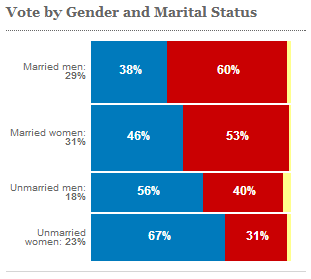
Unmarried v. Married: Election 2012

Graph courtesy of CNN.com
This next set of maps looks at exit polling data comparing unmarried and married people by gender.  It is interesting to see considerable differences between the unmarried -and presumably younger in many cases- voters and likely older voters.

Unmarried women -regardless of living in a Blue/Democratic or Red/Republican state- voted 2-to-1 for Mr. Obama.  Most unmarried men -even those living in most Red states- supported the Democratic ticket.

Married women reflect a pattern closer to the actual state win/loss map.  Their spouses, however, voted primarily Republican -even if living in a Blue state.


Tuesday, December 10, 2013

If Only Latinos Voted

As with yesterday's post, CNN's exit polling data are limited for Latino men and women.  Here are the maps for the existing data:


President Obama won more than 7 of every 10 votes by Latinos in 2012.  

Monday, December 9, 2013

If Only Black Women and Black Men Voted


CNN did not collect exit polling data for a number of states in 2012.  In those states where exit polling was conducted, data on the voting preferences of black and Hispanic Americans are also limited.  In some cases the public data shows results for black women but not black men.  Here are the resulting maps.

President Obama won 9 of every 10 votes -or higher- among black voters.


Sunday, December 8, 2013

If Only White Women Voted


While white men voted solidly for former Gov. Mitt Romney and the Republicans in 2012, the pattern for white women is more complicated.  Women voters supported President Obama by 55% (Obama) to 45% (Romney) overall.  On the other hand, only 45% of male voters supported the Democratic ticket.

If you compare the two maps, you can see that majorities of white women and men were mutual in their support for the Obama ticket in only four states:  WA, OR, VT, and MA.  In another 7 states (CA, NY, NH, ME, WI, IA, and MN), white voters split:  white women supported Obama; white men supported Romney.


Saturday, December 7, 2013

If Only White Men Voted, Part 2

Among the states where CNN gathered exit polling data, Romney won overwhelmingly among white men -a core voting bloc for the GOP. A majority of white male voters supported President Obama's re-election in only four states:  WA, OR, VT, and MA.

In fact, the last time a Democratic presidential candidate won a majority of white voters was in 1964 -and race has a LOT to do with this pattern.  In 1860 the Northern states where slavery was abolished voted solidly for Abraham Lincoln, the Republican candidate.  The Democratic Party had splintered between Northern and Southern interests into the National (Northern) Democratic Party and Constitutional (Southern) Democratic Party.  A fourth party, the Whig Party, had been a strong force in US politics for two decades but had dissolved.  Some former Whigs formed a new fourth party, the Constitutional Union Party, that also ran in the 1860 presidential election.

The Southern slave states voted overwhelmingly for the Southern faction of Democrats or the Constitutional Union Party.  Only Missouri voted for the Northern faction of the Democrats.  The united Republicans in the North successfully elected Lincoln to the White House in 1860.  By April of the next year the US was embroiled in its civil war.

After the Civil War, a basic pattern emerged where the North voted primarily Republican and the "Solid South" supported Democrats overwhelmingly.  In 1964, President Lyndon Johnson, a Southern Democrat from Texas, signed the Civil Rights Act into law.  This law ensured American adults regardless of race could vote.  When he signed the law, Johnson pondered that he might be handing the South over to the Republicans.  Sure enough, white voters revolted.  Since the Civil Rights Act was signed into law, former Dixiecrats have moved en masse to the Republican Party.  No Democratic presidential candidate has broken 50% of the the white vote since 1964 -though Carter, a Southerner, almost did with 48% of the white vote in 1976.

Today the party patterns have largely flipped with the Old South a Republican stronghold in terms of national politics.  Likewise, New England moderate Republicans are all but extinct with the former Union states largely voting Democratic in national elections.

You can compare white male voters' outcomes above to the outcomes for each state for the whole population of voters below:


Friday, December 6, 2013

If Only White Men Voted


Check out the full story at Buzzfeed
The folks over at Buzzfeed did a series of interesting maps outlining the 2012 election results if -as was the law before 1870- only white men could vote.  My hat off to Buzzfeed for showing history in a new and intriguing way.

This led me to exploring CNN's 2012 exit polling data in this next series of maps.

Thursday, December 5, 2013

Election 2012 and Future Demographics

Since the 2012 election, there have been a number of analyses of votes and exit polling data.  The news for the Republican Party has been grim and led to a report by the Republican National Committee outlining the demographic and ideological issues hampering Republicans in national and US Senate elections.

A quick recap:  While the GOP candidate (George W. Bush) ultimately took the majority of electoral votes in 2 elections, the Democratic candidate has won more votes nationally than the Republican presidential candidate in 5 of the 6 last elections.  More Democrats have been elected to the US Senate.  And in 2012 Democratic candidates won more votes overall in US House elections than Republican candidates.

So why isn't the US House controlled now by Democrats?  Good question.  The answer goes back to the 2010 US Census and reapportionment.  The express purpose of having a census every 10 years is to reapportion the US House of Representatives and state legislatures.  Each state -regardless of population- gets 2 US Senators.  US House seats, however, depend on a state's population.  Kentucky for example used to have 8 House seats but its sluggish growth compared to other states led to a reapportionment over the past few decades.  Now Kentucky has 6 House seats.

In 2010 with the recession that began under President Bush in full swing and the Tea Party activists at their zenith, the Republican Party won control of more state legislatures than the Democrats.  When the 2010 Census data came out, both parties set to reapportioning their states -usually to the advantage of their particular party.  Today's US House of Representatives reflects this reapportionment -or gerrymandering in some people's views.  In 2012 all 435 House seats were up for election.  Here are the results:

2012 Election: US House of Representatives
% of Popular Vote
% of House Seats Actually Won
Democratic Party
48.8
46.2
Republican Party
47.6
53.8
Libertarian Party
1.1
0
independents
0.6
0
Green Party
0.3
0
Constitution Party
0.1
0
Reform Party
0.1
0
Independence Party
0.1
0
Source:  US House of Representatives, Office of the Clerk, Election Statistics

If the US House was structured more as a parliamentary system where seats are divided up proportionally to the popular vote, Democrats would control the US House and several smaller parties would have a seat or two.  Instead, because each House seat is determined by the voters only in that seat's district -and these districts were carefully crafted to the advantage of the party in control of the state legislature in 2010-2012, the minority party in the popular vote controls the US House.

This next series of maps explores some of the demographic factors influencing the declining fortunes of the GOP in national popular votes.